Rising majestically at the eastern end of Princes Street, Calton Hill is perhaps the most iconic viewpoint in Edinburgh, Scotland. This volcanic hill is a cornerstone of the city’s skyline, offering a stunning panoramic perspective that captures the historic Old Town, the elegant New Town, and the shimmering waters of the Firth of Forth. Included within the Edinburgh UNESCO World Heritage Site, the hill serves as a public park and a sanctuary of classical architecture, earning Edinburgh its nickname as the “Athens of the North.”
For travel enthusiasts, a visit to Calton Hill is a rite of passage. Unlike the more strenuous hike up Arthur’s Seat, the ascent here is short and manageable, making it accessible to a wide range of visitors. Whether you are looking to capture the perfect photograph of Edinburgh Castle at sunset or simply want to escape the hustle of the city center, Calton Hill provides a peaceful yet dramatic setting. It is a place where the grandeur of Scottish history meets the natural beauty of the Lothian landscape.
History & Culture of Calton Hill
The history of Calton Hill is as layered as the volcanic rock from which it is formed. Archaeological evidence suggests the site has been used for centuries, possibly as a prehistoric hillfort. In the 15th century, King James II granted the land to the community for sports, tournaments, and “warlike deeds.” This military connection persisted for centuries, eventually leading to the construction of the notorious Calton Jail, which once occupied the southern slopes where St Andrew’s House stands today.
During the Scottish Enlightenment in the 18th and 19th centuries, the hill underwent a cultural transformation. It became the centerpiece of Edinburgh’s architectural ambition. Influential figures like William Henry Playfair and Robert Adam envisioned the hill as a “monumental landscape” that would mirror the Acropolis of Athens. This era saw the birth of the Greek-revival monuments that define the hill’s character today.
Culturally, Calton Hill remains a vibrant part of Edinburgh’s civic life. It is the site of the annual Beltane Fire Festival, a modern reimagining of an ancient Celtic ritual held every April 30th to celebrate the beginning of summer. This fusion of ancient tradition and Enlightenment architecture makes the hill a unique symbol of Scottish identity, blending the scientific pursuit of astronomy with the fiery roots of Celtic folklore.
What Calton Hill Is Famous For
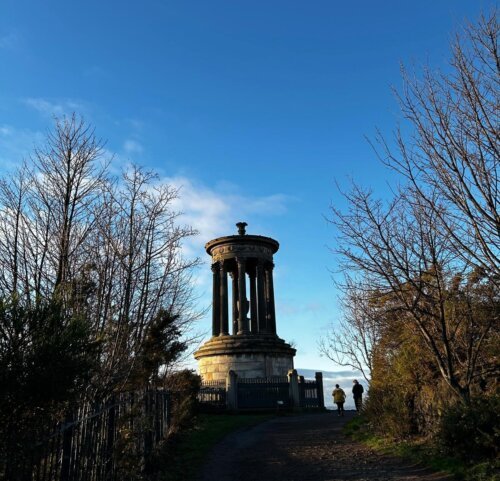
Calton Hill is most famous for its extraordinary collection of monuments and its unparalleled views. It is the primary location for the “classic” photo of Edinburgh, featuring the Dugald Stewart Monument in the foreground with the Balmoral Hotel clock tower and Edinburgh Castle in the distance. This single vantage point is one of the most photographed spots in the United Kingdom.
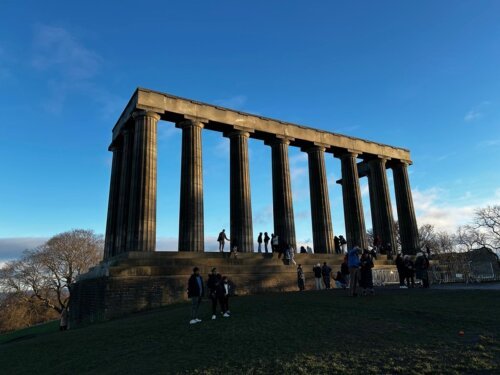
The hill is also famously known for the National Monument of Scotland. Modeled after the Parthenon in Athens, it was intended to commemorate Scottish soldiers who died in the Napoleonic Wars. However, construction ceased in 1829 due to a lack of funds, leaving only twelve massive columns standing. This led to its humorous nicknames, “Edinburgh’s Disgrace” or “Scotland’s Folly,” though today it is a beloved landmark that locals and tourists alike enjoy climbing for a better view.
Furthermore, Calton Hill is a historic hub for science and timekeeping. The Nelson Monument, which looks like an upturned telescope, houses a “time ball” that still drops at 1:00 PM every day (except Sundays). This historically allowed sailors in the Port of Leith to synchronize their chronometers. The presence of the City Observatory further cements the hill’s reputation as a place where the city looked toward the heavens.
Things to Do in Calton Hill
Witness the Sunrise or Sunset
One of the most popular activities on Calton Hill is watching the sky change color over the Edinburgh skyline. Because the hill offers 360-degree views, it is equally spectacular at dawn and dusk. Sunset is particularly busy, as the sun dips behind the Castle and the spires of the Old Town, casting a golden glow over the stone architecture.
Climb the Nelson Monument
While the hill itself is free, you can pay a small fee to climb the 170 steps to the viewing platform of the Nelson Monument. From here, you are at the highest point of the hill complex, offering a clear sightline all the way to the Kingdom of Fife and the Pentland Hills. It provides a unique vertical perspective of the surrounding monuments.
Explore Contemporary Art at Collective
The former City Observatory has been transformed into “Collective,” a center for contemporary art. You can walk through the restored scientific buildings and view rotating exhibitions by local and international artists. The site expertly blends historic scientific instruments with modern creative expressions, making it a must-visit for art lovers.
Photography and Picnicking
For photographers, the hill is an endless source of inspiration. Beyond the main monuments, the northern side offers views of the Firth of Forth and the Port of Leith. Many locals bring a picnic and sit on the grassy slopes during the summer, enjoying the breeze and the expansive views of Arthur’s Seat to the south.
Places to Visit in Calton Hill
The National Monument
As the most prominent structure on the summit, the National Monument is a great place to start your exploration. The sheer scale of the Craigleith sandstone columns is impressive up close. It is a popular spot for visitors to sit and rest while taking in the views toward the Royal Mile.
Dugald Stewart Monument
Designed by William Henry Playfair in 1831, this circular temple commemorates the Scottish philosopher Dugald Stewart. While you cannot enter the monument, it serves as the framing device for the most famous photograph of Edinburgh’s skyline.
Robert Burns Monument
Located on the southern slope along Regent Road, this monument is a Greek-style choragic monument dedicated to Scotland’s national poet. It is slightly removed from the main summit, offering a quieter space to appreciate the neoclassical design.
Old Calton Burial Ground
Just a short walk from the foot of the hill lies this atmospheric cemetery. It is the final resting place of several notable figures, including the philosopher David Hume. The site features the tall obelisk of the Political Martyrs’ Monument, visible from several points on the hill.
Travel Guide to Calton Hill
Navigating your visit to Calton Hill is relatively simple, as its central location makes it one of the easiest landmarks to reach in the city.
Best time to visit Calton Hill
The best time to visit is during the late afternoon in the spring or autumn. During these seasons, the “golden hour” light is particularly beautiful for photography, and the temperature is usually comfortable for the walk up. August is the busiest month due to the Edinburgh Festivals, so if you visit then, try to go early in the morning to avoid the largest crowds. Winter visits are also rewarding, especially if there is a light dusting of snow, though the hill can become very windy and cold.
How to reach Calton Hill
The main entrance to Calton Hill is located on Regent Road at the east end of Princes Street. From Edinburgh Waverley Station, it is a mere 5-10 minute walk. You can either take the flight of stairs located near the entrance or follow the paved, inclined road that winds up to the summit. Most major city center bus routes stop at the foot of the hill, and the tram stop at St Andrew Square is also within easy walking distance.
Entry fees or ticket details
Access to Calton Hill and the majority of its monuments is completely free of charge. It is a public park open 24 hours a day. The only attraction that requires a paid ticket is the Nelson Monument if you wish to climb to the very top. Tickets for the Nelson Monument can be purchased at the base of the tower.
Local food, cuisine, or specialties
For a high-end dining experience, “The Lookout by Gardener’s Cottage” is perched on the hill and offers seasonal Scottish dishes with floor-to-ceiling views of the city. For something more casual, there is often a mobile coffee van at the summit. At the bottom of the hill on Broughton Street, you will find numerous independent cafes and traditional Scottish pubs where you can try haggis, cranachan, or locally brewed craft ales.
Accommodation options
Luxury: The Balmoral Hotel is an iconic choice located at the end of Princes Street, offering world-class service and views directly toward Calton Hill. Mid-range: The Apex City of Edinburgh Hotel or the Courtyard by Marriott Edinburgh are excellent options nearby that offer modern amenities and easy access to the hill. Budget: For those on a budget, the Castle Rock Hostel or various guesthouses in the nearby New Town area provide affordable stays in historic buildings.
Safety, accessibility, and responsible tourism tips
The main paths on Calton Hill are paved, but they can be steep. Visitors with limited mobility may find the incline challenging, although there is a vehicle access point that can be used by prior arrangement with the City Council. Always stick to the paths to protect the grass and historic structures. As a responsible traveler, ensure you take all your litter with you, as the hill is a sensitive heritage site.
Travel Tips for Calton Hill
Wear layers even if it seems warm in the city center. The hill is significantly more exposed than the streets below, and the wind from the North Sea can be biting. A windproof jacket is highly recommended.
Bring a tripod if you are interested in night photography. The city lights of the Old Town and the illuminated Edinburgh Castle make for stunning long-exposure shots from the Dugald Stewart Monument.
Check the timing of the Beltane Fire Festival if you are visiting at the end of April. The hill is closed to the general public during the ticketed event, so plan your visit for earlier in the day if you don’t intend to stay for the festival.
Combine your visit with a walk down the Royal Mile. Since Calton Hill sits at the eastern end of the city center, it is a great starting point for a walk toward Holyrood Palace and the Scottish Parliament building.
FAQs
Is Calton Hill free to visit?
Yes, Calton Hill is a public park and is completely free to enter at any time of the day or night. You only need to pay a small fee if you wish to climb the Nelson Monument.
How long does it take to walk up Calton Hill?
The walk from the base at Regent Road to the summit usually takes between 5 to 10 minutes depending on your pace. It is a short but steady incline on a well-paved path.
Can I see Edinburgh Castle from Calton Hill?
Absolutely. Calton Hill offers one of the best unobstructed views of Edinburgh Castle. It is the most popular spot for capturing the castle alongside the iconic skyline of the Old Town.
Is Calton Hill open at night?
Yes, Calton Hill is open 24/7. It is a safe and popular spot for locals and tourists to view the city lights at night, though you should always stay on the main paths.
What are the columns on Calton Hill?
The columns belong to the National Monument of Scotland. It was designed to look like the Parthenon in Athens but was left unfinished in 1829 because the project ran out of money.
Is Calton Hill suitable for children?
Yes, children usually enjoy exploring the large monuments and running on the grassy slopes. However, be cautious near the National Monument as the steps are very large and can be slippery when wet.
Where is the best photo spot on Calton Hill?
The most famous photo spot is just behind the Dugald Stewart Monument. From here, you can frame the monument in the foreground with the city center and Edinburgh Castle in the background.
Are there toilets on Calton Hill?
There are limited public toilet facilities at the summit, often associated with the Collective gallery or the Lookout restaurant. It is best to use facilities in the nearby shopping centers before ascending.
Can you drive to the top of Calton Hill?
General public vehicle access to the summit is not permitted. Visitors must walk up from Regent Road. However, disabled access can sometimes be arranged in advance through the City of Edinburgh Council.
What is the “Athens of the North”? “
Athens of the North” is a nickname for Edinburgh that became popular in the 19th century. It refers to the city’s intellectual Enlightenment and the Greek-revival architecture found prominently on Calton Hill.
Leave a Review Cancel reply
I am a passionate freelance web designer creating visually appealing, high-performance websites. I craft engaging, user-friendly digital experiences that help startups and brands grow through clean design and seamless functionality.
Sorry, no records were found. Please adjust your search criteria and try again.
Sorry, unable to load the Maps API.
1 Reviews on “Calton Hill”
I visited Calton Hill last October just as the sun was starting to set, and it was truly a magical experience. I’ve traveled all over Europe, but the view from the Dugald Stewart Monument toward Edinburgh Castle is something I will never forget. The walk up was much easier than I expected—only about five minutes from the main road—which was a relief after a long day of walking the Royal Mile. Standing among the giant columns of the National Monument made me feel like I had stepped back into ancient Greece. If you only have one evening in Edinburgh, make sure you spend it here. It’s free, central, and offers the absolute best perspective of this beautiful city!